Reading relationships, not a single feature
Face reading traditions observe face shape, forehead, eyebrows, eyes, nose, cheeks, mouth, jaw, ears and overall balance. No single feature deserves to be used alone to conclude something about a person.
The relationships between features, the expression at the time of the photo, age, lighting and natural variation all need to be considered. The language of the reading should be reflective, not stereotyped.
- Start from overall proportion.
- Read combinations of features.
- Avoid moral judgements from appearance.
Three zones and symbolic phases
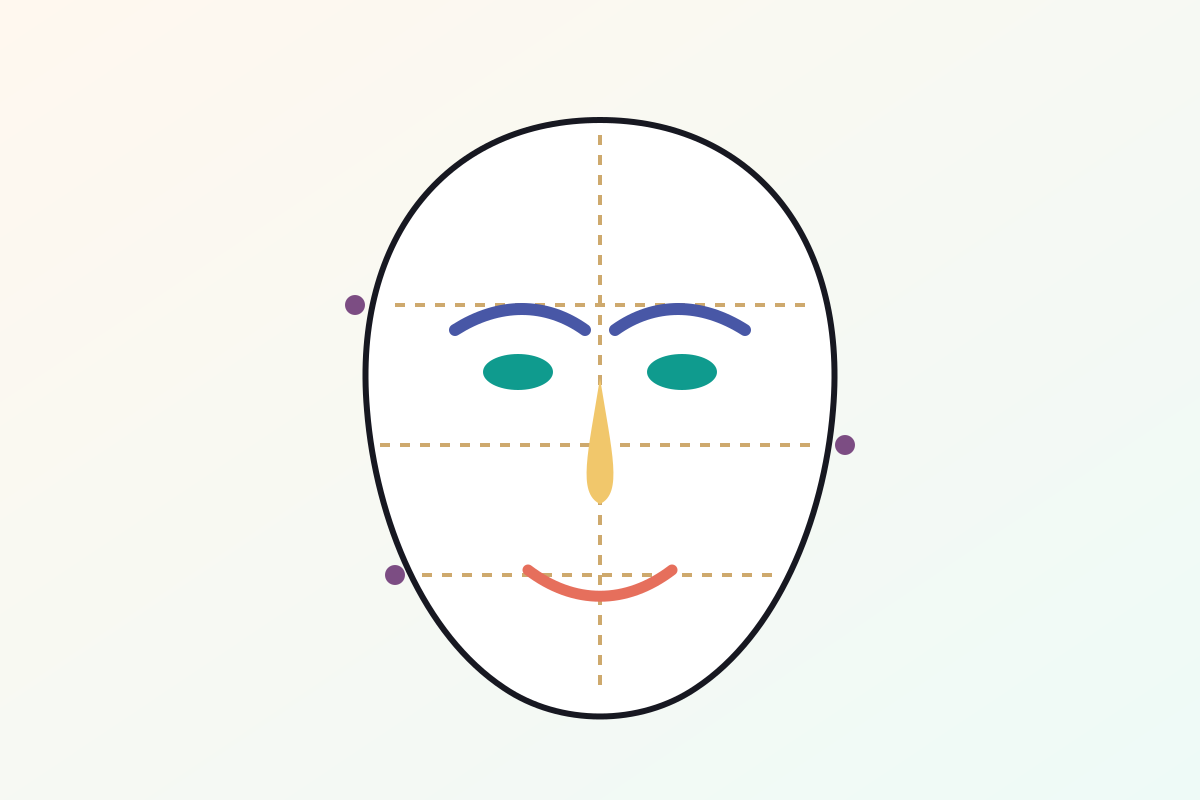
Several traditions divide the face into upper, middle and lower zones. These zones are used to discuss mental orientation, interaction with the world, practical drive, or phases of life symbolically.
This division is not a biological measurement of personality. It is a traditional framework that helps build a narrative, and the result must leave room for the user to confirm or reject it.
- Upper zone: orientation and vision.
- Middle zone: relationship with the world.
- Lower zone: drive and practical capacity.
Expression, symmetry and change
Temporary expression can change the eyes, lips, lines and tension in the face. Symmetry is also affected by camera angle and lighting. A neutral, front-facing photo is therefore more useful than an angled selfie or a dramatic pose.
Face reading for children requires greater care because features are still developing. Results must never become labels that limit a child's growth, education or family expectations.
- Use a neutral front-facing photo.
- Distinguish fixed features from momentary expression.
- Never give a child a permanent label.
The ethical limits of face reading
A face cannot prove intelligence, health, criminality, ethnicity, orientation, honesty or personal worth. Results must not be used for recruitment, diagnosis, security or any decision that affects rights.
Only use your own photo or a photo whose owner has given permission. Privacy and consent are basic requirements.
Face Reading at HDTIX
The HDTIX module analyses a front-facing photo to compose traditional patterns about character expression, strengths, challenges, phases and direction of growth. Adult and child modes use different approaches.
Treat the result as a reflective story that can open a conversation about yourself, not as objective truth about someone's identity.
- Use a photo with permission.
- Protect personal biometric data.
- Accept only insights that match experience.
Frequently asked questions
What kind of photo is best?
A front-facing photo with a neutral expression, even light, no filters, and clearly visible features.
Can a child's face be read?
Only with a guardian's permission and very careful language; never give permanent labels because children are still developing.
Can a face prove character?
No. Face reading is an interpretive tradition, not an objective tool for determining morality or ability.