Why a blueprint needs synthesis
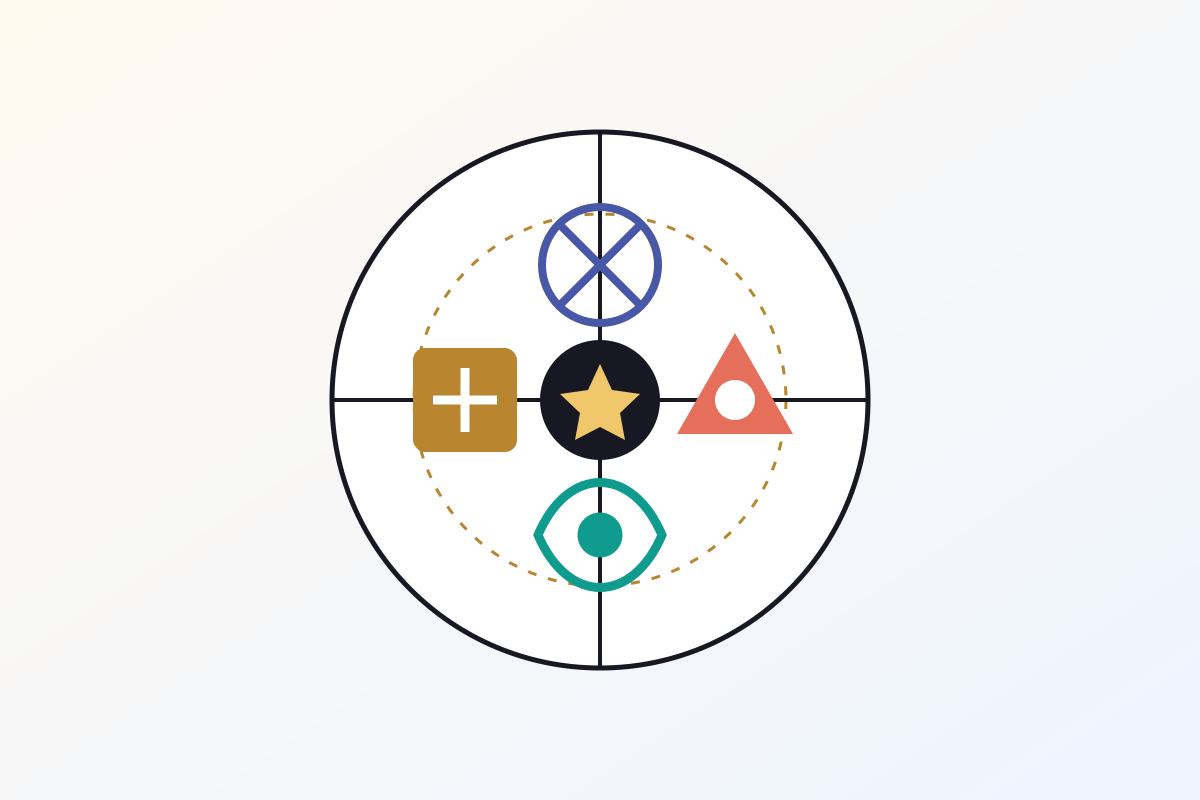
Every system has a different point of view. Human Design emphasises how energy and decisions work, Astrology gives language for planets and life areas, Bazi reads elemental archetypes and timing, while Numerology highlights numerical patterns from a name and birth date.
Synthesis is not a pile of terms. The aim is to choose the two or three factors most relevant to the question, then see whether those factors reinforce each other or reveal a tension that needs managing.
- The question determines which data gets priority.
- Each system keeps its original function.
- Contradictions are read as dynamics, not mistakes.
The distinct role of each system
In Human Design, Type, Strategy and Authority help discuss how to move and decide. In Astrology, planets are chosen to fit the context: the Moon for emotional needs, Venus for values and relationships, Mars for drive, the MC for public direction, or Saturn for maturity.
Bazi can give elemental language about resilience and the need for balance. Numerology distinguishes the Life Path journey, the way potential is channelled, inner needs, outer impression, contribution and the lessons of maturing.
- Career needs a different lens than relationships.
- Missing data must never be guessed.
- Technical terms are only used when they clarify the answer.
Writing a question that can be answered
Blueprint Advice is most useful for questions about yourself, decision patterns, career, relationships, expression or a phase of development. Describe the real situation, the options available, and the part that makes you most uncertain.
Avoid questions that ask a system to determine your life entirely. A stronger form asks for the relevant personal patterns, the blind spots that may be active, and a way of acting that fits better.
- Include context and purpose.
- Ask about your own patterns, not what someone else is thinking.
- Ask for concrete actions you can test.
From insight to decision
A good synthesis opens with the core advice, shows the supporting data, discusses strengths and blind spots, and closes with concrete steps. The user still needs to judge whether the recommendation fits the facts, their capacity and the consequences.
A blueprint is best used to improve the quality of your questions and decisions, not to avoid uncertainty. When several systems disagree, the differences can explain the pull between inner needs, outer presentation and environmental demands.
Blueprint Advice at HDTIX
HDTIX lets users choose which blueprint sources to use. The system then takes the relevant data and composes it into personal, sharp, spiritual yet grounded advice.
For the best result, make sure the birth data and name are correct. Choose only the sources whose data is available, raise one main focus, and treat the result as reflection material before taking any real step.
- Check the accuracy of the input data.
- Use one focus per session.
- Note the patterns that keep returning.
Frequently asked questions
Do all the systems have to be used every time?
No. Use the sources that are available and relevant to the question so the reading does not become crowded.
What if the systems disagree?
Differences can be read as a dynamic tension between needs, expression, decisions and environment.
Can Blueprint Advice determine the best decision?
It can give perspective and priorities, but responsibility for the decision stays with the user.