A direct card system
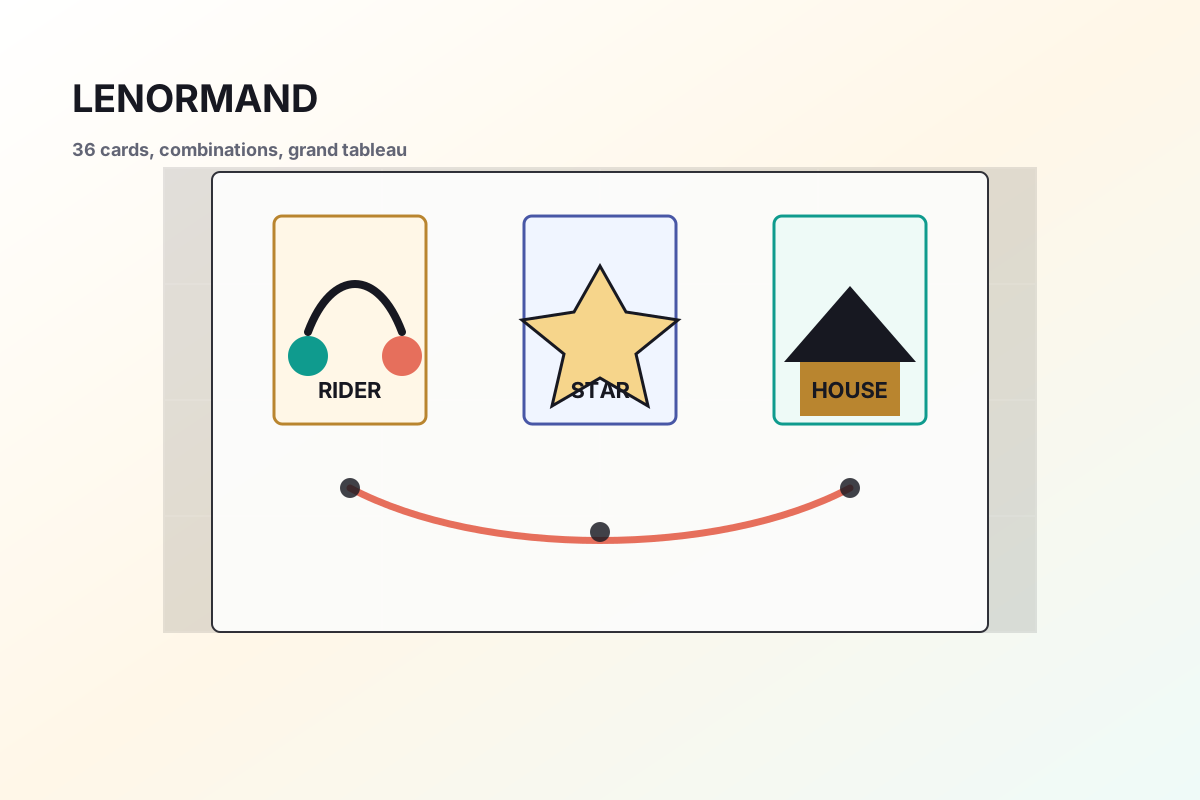
Lenormand is different from tarot. It uses 36 cards with more concrete symbols such as the Rider, Clover, Ship, House, Tree, Clouds and Snake. Its language tends to be practical, concise and situational.
Where tarot often opens archetypal and psychological layers, Lenormand is more like reading a sentence. Cards are combined to form a clear message about a situation.
- Each card has concrete keywords.
- Meaning emerges from combinations, not from a single card.
- Specific questions produce sharper readings.
Combinations as grammar
In Lenormand, two or three cards can be read like a phrase. One card may give the subject, the next gives the quality, and another gives the direction. That is why combination practice matters so much.
Readers also pay attention to position, distance, direction and significator cards. In the Grand Tableau, all 36 cards are laid out to see the larger map of a situation.
Practical without losing depth
Because Lenormand is direct, it suits daily questions, relationships, work, travel and the dynamics of communication. But direct does not mean shallow. Card combinations can produce very detailed readings.
The key is not to force a far-fetched psychological meaning when the cards are speaking concretely.
- Read the cards as a sequence of messages.
- Keep questions clear and measurable.
- Use the Grand Tableau for the big picture, not for every small question.
Lenormand at HDTIX.com
At HDTIX.com, Lenormand enriches the more practical side of the divination ecosystem. It can sit alongside tarot: tarot opens archetypal layers, Lenormand clarifies the details of a situation.
For users who like concise answers, Lenormand is an enjoyable learning tool that delivers results quickly.
Frequently asked questions
Is Lenormand easier than tarot?
Many beginners find Lenormand more direct, but combination technique and the Grand Tableau still require practice.
How many Lenormand cards are there?
The classic Lenormand system uses 36 cards.